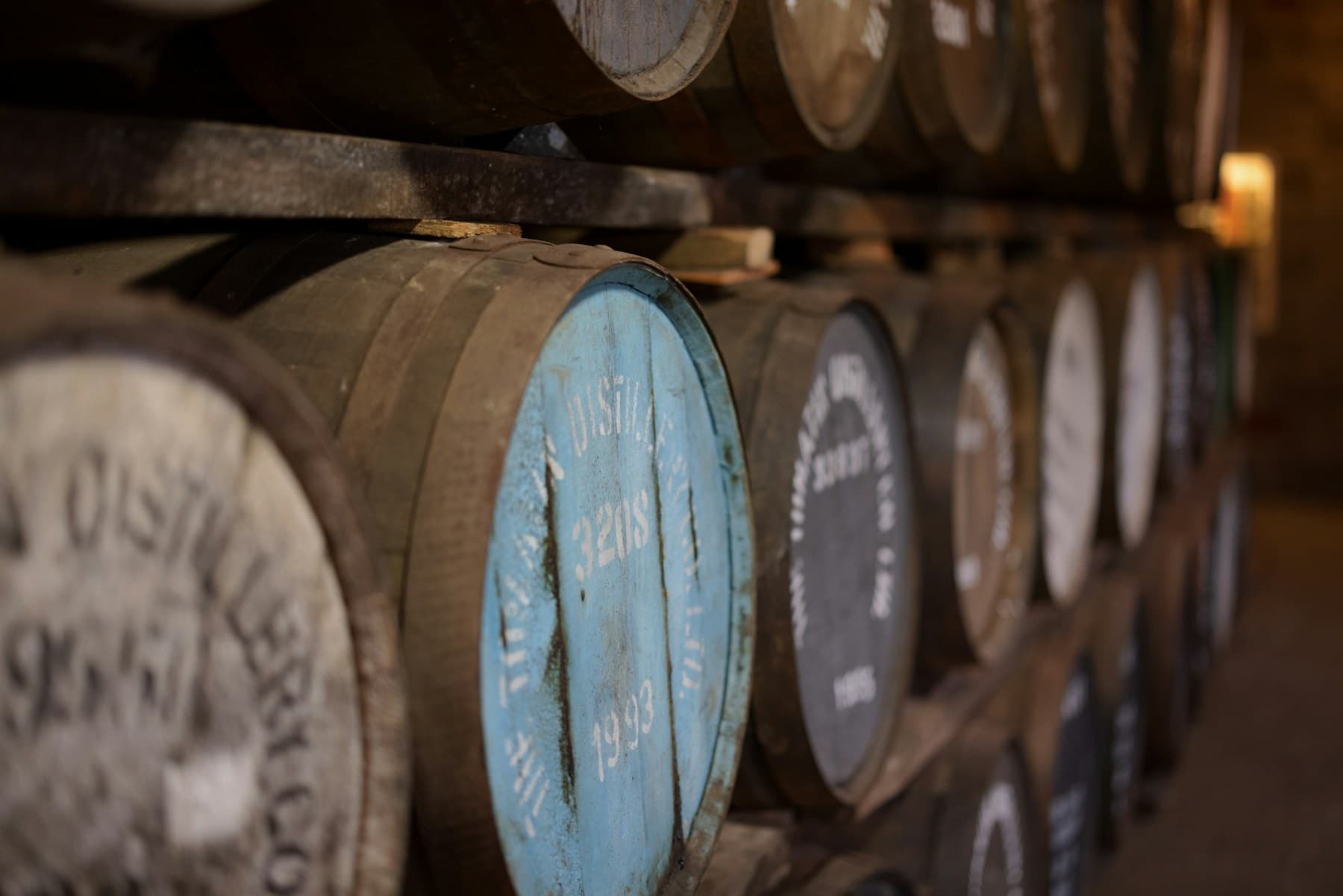
Angel's Share: what evaporates during maturation
Angel's Share is the small part of a spirit that evaporates through a wooden cask during maturation. The term has long been part of whisky vocabulary.
 AI-generated
What time takes.
Explore ten years of maturation in a single movement.
204.27L
Illustrative model · 250 L starting volume (hogshead), 150 equal shares, 2% annual volume loss. No dilution or further losses. Bottle equivalents are not an allocation or promised yield.
What the term means
A wooden cask is not completely airtight. During storage, a slow exchange takes place between cask, air and spirit. A small part escapes over the years.
The poetic name Angel's Share describes this natural process. It is not a promise of quality, but part of cask maturation.
Why warehouse and climate matter
Temperature, humidity and a cask's position in the warehouse influence maturation. This is why even comparable casks do not develop in exactly the same way.
Time in the warehouse changes colour, texture and aroma. Each cask follows its own path through wood, spirit and surroundings.
The term and our brand
ANGELS' SHARE® cask shares deliberately references this established whisky term. The focus is on selected casks and understandable maturation.
A cask profile should make clear where a cask comes from and what shapes its time in wood.
What actually disappears during storage
A wooden cask is not an airtight tank. During storage, components of the liquid can pass through the wood into the surrounding air. This evaporation loss is traditionally called the angel’s share. The poetic name describes a real part of maturation. It does not mean that every cask loses the same amount each year, or that a fixed deduction can be calculated for every individual share.
There is more to this than the number of litres. The cask contains water, alcohol and many other substances. Water and alcohol do not evaporate in the same proportions under all conditions, so liquid volume and alcoholic strength can develop differently. Both measurements matter when assessing a cask. Looking only at the remaining litres overlooks another quantity that is just as important for bottling: the measured strength of the contents.
Two per cent is an assumption, not a fixed property of your cask
Our illustrative calculation uses an annual volume loss of two per cent. This is a model assumption, not a measurement of the casks on offer. An individual cask may develop differently. Seasons, storage conditions, the condition of the wood and its storage history make a simple projection uncertain. When a provider quotes a future bottle count, it should be clear whether the figure is based on a recent measurement or an assumption.
The basis of the percentage also needs to be clear. Two per cent of the remaining contents is not the same as two per cent of the original fill every year. In the first case, the absolute annual loss decreases over time; in the second, it stays constant. Our model explicitly uses the remaining volume at each step. This distinction may seem small, but it changes the result over several years and should be clear in any projected yield calculation.
Ten years in a 250-litre example
We start with 250 litres. After one year with a two per cent loss, 245 litres remain; after two years, 240.10 litres; and after four years, approximately 230.59 litres. After ten years, roughly 204.27 litres remain. The formula is initial volume × 0.98 raised to the number of years. The total loss in this example is about 45.73 litres, or 18.3 per cent of the original volume. Subtracting ten lots of two per cent of the initial volume would instead leave 200 litres.
A comparison shows how sensitive the result is to the assumption. At one per cent annual loss, around 226.10 litres would remain after ten years. At three per cent, the figure would be about 184.36 litres. These scenarios are neither forecasts nor promised upper and lower limits. They simply show why a small change in the annual assumption becomes significant over time. A recent measurement report is therefore more informative than an apparently precise final figure derived solely from a general rule of thumb.
What this means for a cask share
If our fictional 250-litre cask were divided into 150 equal shares, each share would initially represent around 1.667 litres. After ten years in the two-per-cent model, that would be approximately 1.362 litres. With 0.7-litre bottles and no added water, this is roughly 1.945 bottle equivalents per share, before sampling and bottling losses. The number of shares stays the same in the model; the calculated volume represented by each share changes.
The same relationship applies to a larger allocation. Ten of 150 shares represent approximately 6.67 per cent of the cask. After ten years, that would amount to around 13.62 litres in the model. How this becomes whole bottles, and how any remainder is distributed, is a separate matter governed by the agreement. The angel’s share explains evaporation loss, not an allocation rule. An originally estimated bottle count should not later be treated as a promised minimum quantity.
Consider the wood and storage environment together
A small cask has a different ratio of wood surface to contents than a large one. The individual staves, the soundness of the cask and its previous use also matter. A description such as bourbon barrel or sherry hogshead does not, on its own, establish an exact evaporation rate. Cask type helps explain the profile, but does not replace checks on the individual cask. Two outwardly similar casks can produce different measurements over the same period.
The surroundings include temperature, humidity and air movement. Position within the warehouse may also matter. These factors explain why a general calculation cannot guarantee next year’s result. Rather than attributing every difference to a single cause, it is more useful to compare documented measurements over time. Their method, date and units should be clear. Only then can you judge whether two figures are genuinely comparable.
Keep evaporation separate from other losses
Not every reduction in liquid volume is automatically the angel’s share. Taking samples, transferring the contents and preparing for bottling can also reduce the amount remaining. A leak is different again from normal evaporation during maturation. Recording these events separately makes the documentation more transparent. Otherwise, one figure may suggest unusually high annual evaporation when some liquid was also removed for a tasting.
If a measurement differs unexpectedly, the useful question is not simply how much evaporated. Also ask when the last sample was taken, whether the cask was moved or its contents transferred, and what volume the measurement refers to. Final bottling involves further practical steps. A theoretical calculation based on warehouse contents does not automatically give the exact number of finished bottles. That figure can only be documented once bottling is complete.
The term and the Angels’ Share platform
Our name refers to this part of cask maturation. The connection is to the product itself: choosing a cask share means following something that changes over time, both in flavour and in the quantity eventually available. The name does not describe an additional fee or a particular amount of liquid taken by Angels’ Share. The term should therefore not be confused with a rule for distributing the cask’s contents.
When comparing actual cask profiles, follow a simple sequence: first check the cask number and date, then the volume and alcoholic strength, followed by the intended bottling strength and bottle size. Only then calculate a possible yield. If current data is missing, the calculation remains a scenario. Keeping that distinction clear helps you follow a cask’s story without confusing measurements and assumptions. A useful report distinguishes what is known, what has been calculated and which bottling decisions remain open.
Journal
Continue the cask story.
Three carefully chosen reads that add the next useful chapter.
Frequently asked questions
- What does Angel's Share mean?
- Angel's Share is the small part of a spirit that evaporates through a wooden cask during maturation.
- Why does whisky evaporate in a cask?
- Wooden casks are not completely airtight. During storage, a slow exchange takes place between the cask, air and spirit.
- Does the warehouse influence maturation?
- Yes. Temperature, humidity and storage position influence how a cask develops over time.